
Artikel: essential oils for stress

essential oils for stress
how scent, ritual and tradition come together
When life feels fast, scent can offer a softer way back. Essential oils for stress have been used for centuries in daily rituals, and today they remain one of the most intuitive ways to create a sense of calm, grounding, and reset.
There are moments when stress does not feel dramatic. It feels constant. A full mind, tight shoulders, shallow breathing, the sense that the day is moving faster than you are.
This is often where scent begins to matter.
Essential oils for stress are not new. They belong to a much older rhythm of living with plants - through smoke, baths, anointing oils, fragrant woods, resins, herbs and steam. Across cultures and centuries, aromatic botanicals have been used to soften the atmosphere, mark transitions, and support a calmer inner state. Modern aromatherapy gives this tradition new language, but the instinct itself is ancient.
what essential oils are, in the first place
Essential oils are concentrated aromatic compounds extracted from plants. They carry the scent profile of leaves, flowers, peel, wood, resin, or herb, the part of the plant that gives it its characteristic aroma.
That concentration is part of why they feel so immediate. A few drops can change the atmosphere of a room. A familiar note can make the body soften before the mind has found the words.
At 1331, this is where scent becomes more than fragrance. It becomes a ritual of return, quiet, botanical and close to everyday life.
how essential oils work in the body
One reason scent can feel so immediate is that smell has a direct relationship with the brain’s emotional and memory systems. When you inhale an aroma, scent molecules stimulate receptors in the nose, sending signals through the olfactory system to parts of the brain involved in emotion, memory, and stress response.
This is why certain scents can feel comforting, clearing, or grounding within moments. Essential oils do not need to be loud to be effective in a ritual. Often the shift is subtle. A slower breath. A softer mood. A calmer atmosphere.
That does not mean every oil works the same for every person. Scent is personal. Memory is personal. What feels quiet and steady to one person may feel too sharp or too floral to another. The most supportive ritual is often the one you want to return to.
which essential oils are most associated with stress relief
The research around aromatherapy and stress is still evolving, but some oils appear again and again in both traditional use and modern practice. Lavender, bergamot, sweet orange, and grounding woods or resins are among the botanicals most often associated with calm.
lavender
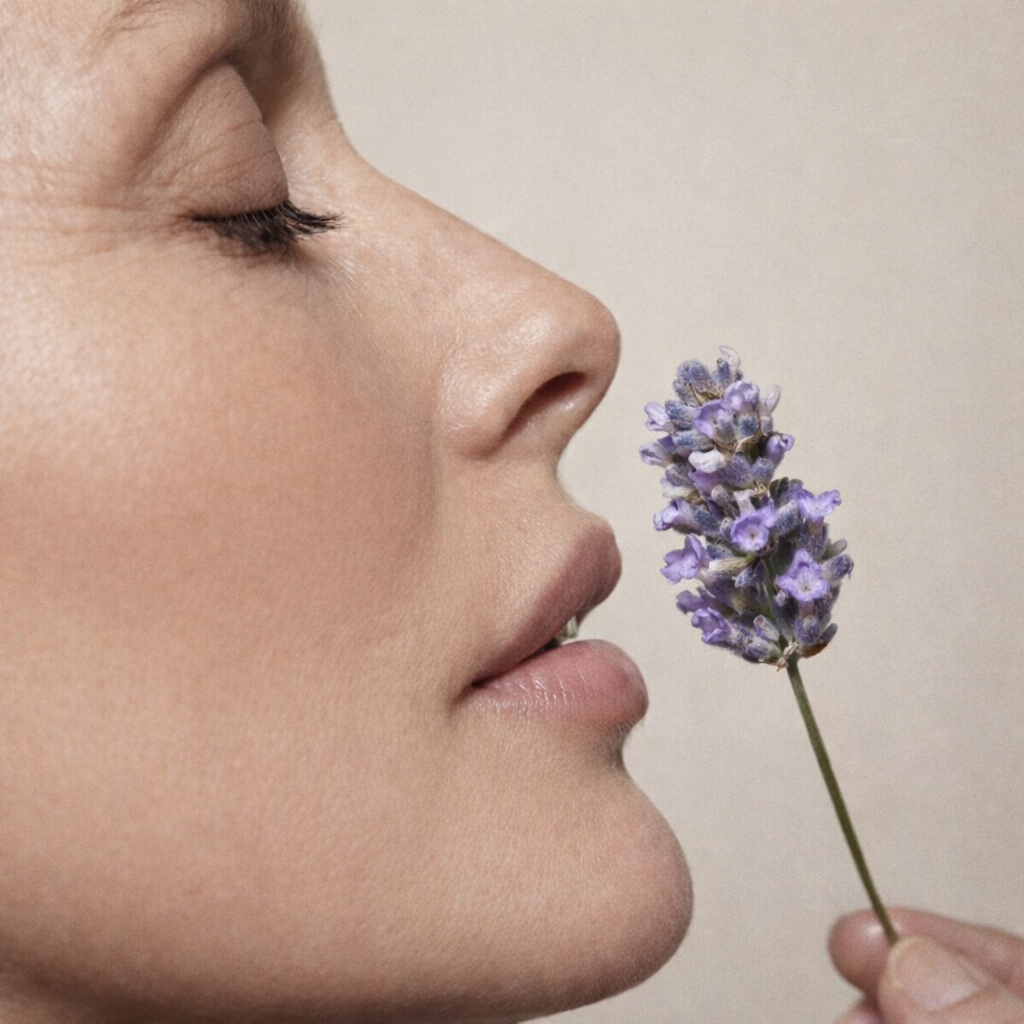
Lavender is perhaps the most familiar calming oil. It has long been associated with rest, softness, and evening rituals. In modern aromatherapy, it is often used when the goal is to quiet the edges of the day and create a sense of ease.
For a softer lavender ritual, explore peace and cloud.
bergamot
Bergamot offers a different kind of calm. Brighter and lighter than lavender, it is often chosen when stress feels mental rather than heavy, a sense of pressure, overstimulation, or emotional static. It can help create an atmosphere that feels clear, airy, and gently uplifting.
sweet orange and citrus oils
Citrus oils are often chosen for stress that feels dull, tense, or emotionally flat. They can bring freshness, brightness, and movement without feeling harsh. In ritual, citrus scents can help shift the mood of a room and create a more open, light-filled atmosphere.
If you are drawn to citrus scents, Sun offers a brighter, more uplifting interpretation.
frankincense, cedar, pine, and other grounding woods and resins
Not every calming scent is soft or sleepy. Some are grounding. Woods, resins, and forest notes are often used when the nervous system feels scattered and the mind needs steadiness more than softness. This older aromatic language — pine air, cedar, smoke, resin, forest floor — appears throughout traditional practices and still resonates in modern ritual because it helps create atmosphere as much as effect.
For a more earthy, steadying approach, explore the calm and grounding collection.
why ritual matters as much as the oil itself
A scent on its own can shift a room. A ritual gives that shift somewhere to land.
This is why essential oils for stress often feel most supportive when they are repeated in a simple, recognizable way. A few drops before the workday begins. A room mist when you come home. A pause at the window before bed. The nervous system responds not only to the aroma, but also to repetition, association, and the cue that it is safe to transition.
This is one of the quiet strengths of aromatherapy. The ritual becomes a signal. Over time, the body learns the pattern: this scent means exhale, this scent means evening, this scent means return.
a traditional practice, made personal
Long before aromatherapy became a modern wellness term, aromatic plants were part of daily and ceremonial life. Herbs were steeped, burned, infused, carried, applied, and scattered. Lavender was linked with bathing and washing traditions. Forest botanicals were used in steam, smoke, and restorative bathing rituals. Citrus peels and resins brought freshness, atmosphere, and presence to domestic and sacred spaces.
What lasts from these traditions is not only the plant itself, but the act around it.
To use scent with intention is to create a threshold. Between work and home. Between noise and quiet. Between carrying the day and setting it down.
That is why a grounding blend can feel especially helpful when paired with habit. The shinrin yoku essential oil blend draws on a forest bathing mood, while gaia pure essential oil blend leans earthy, herbal and rooted.
choosing the best essential oils for stress
The best essential oils for stress are often the ones that match the feeling beneath the stress.
If stress feels buzzy and mental, softer citrus, bergamot, or airy herbal notes may feel clearer and lighter.
If stress feels heavy or overstimulated, lavender, gentle florals, and quiet evening blends may help create a sense of softness.
If stress feels untethered, scattered, restless and hard to settle, grounding woods, pine, cedar, juniper, sage, and resinous notes often feel more supportive.
This is less about chasing a miracle ingredient and more about finding a scent profile your body trusts.
a small ritual to begin with
Try this once, without expecting too much.
Place a few drops of a calming or grounding blend in a diffuser, or mist the room lightly. Stand still for one full breath. Then another. Let the scent arrive before you label it. Notice whether it feels green, warm, woody, citrusy, herbal, or soft.
Use the same scent at the same moment of day for a week, before sleep, after your last call, when you come home, or before you begin work. Very often, the shift comes not from intensity but from repetition.
Because stress rarely leaves all at once. But the body can learn a gentler pattern.
Explore the quieter side of scent through the calm and grounding collection.
Hinterlasse einen Kommentar
Diese Website ist durch hCaptcha geschützt und es gelten die allgemeinen Geschäftsbedingungen und Datenschutzbestimmungen von hCaptcha.